
Picking a difficulty before Eggwina steps onto the road
Difficulty is chosen once, before the stake, and it holds for the whole round that follows.
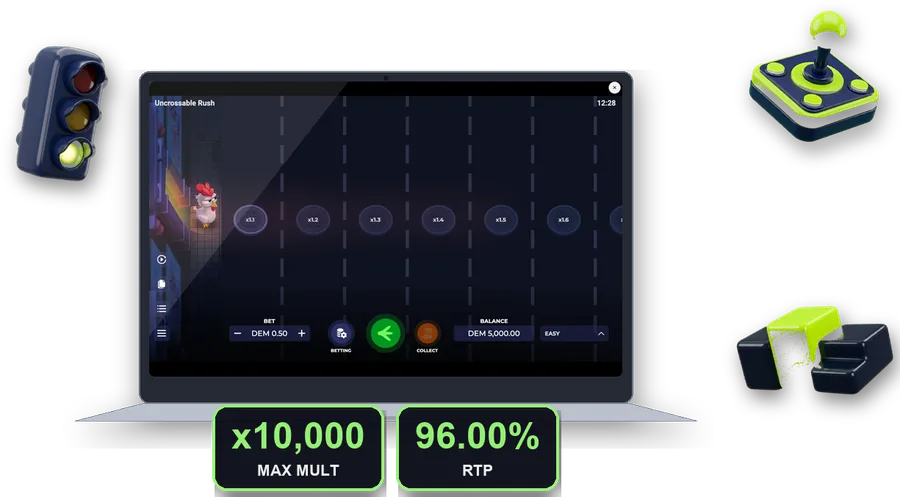
Uncrossable Rush opens with a choice made before any traffic starts moving: Easy, Medium, Hard or Hardcore. Evoplay states plainly that raising this setting increases both the speed of the traffic and the number of cars on the 24-lane road, so the pick made here decides what the very first lane looks like, not just what a completed round might pay.
The setting cannot be adjusted once the round has started. Whatever traffic density Easy, Medium, Hard or Hardcore produces stays fixed for every lane still ahead, from the first crossing to the last one attempted before a cash-out or a collision ends the round.
Evoplay ties the same setting to payouts on rounds that go well, without publishing a separate figure for how much higher at each level. What is confirmed is the relationship, not a number: a higher setting raises both the risk on any given lane and what a successful crossing is ultimately worth.
Hardcore is the setting tied to the game's published x10,000 maximum multiplier, shown on the difficulty-selection screen inside the game's own engine rather than stated in Evoplay's marketing text. Reaching that ceiling is not guaranteed by picking Hardcore; it only makes the ceiling reachable at all.
Setting the stake that rises with every safe crossing
The stake is fixed before the round starts and grows with each lane crossed, rather than being wagered lane by lane.
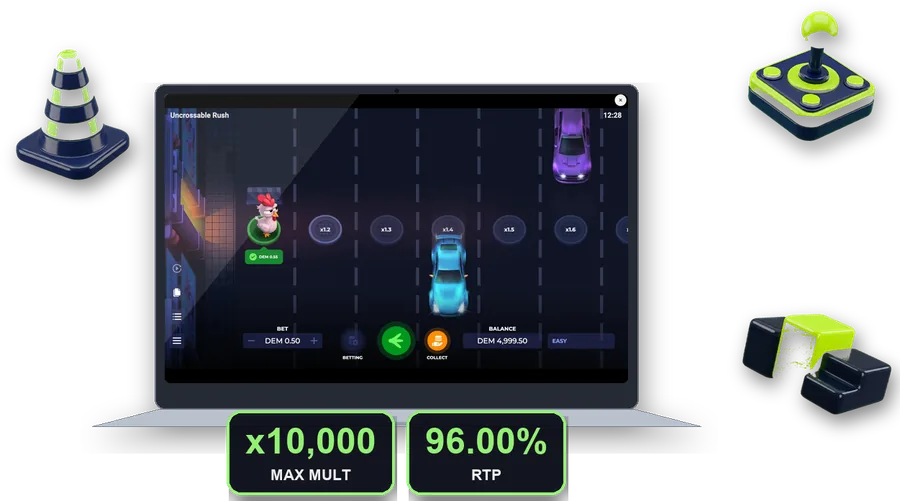
The second choice made before Eggwina steps onto the road is the stake. Evoplay does not publish a minimum or maximum figure for it, so this page cannot state a bet range the way it can for the game's other numbers; what is confirmed is only what the stake is for, not what it can be set to.
That stake is not spent lane by lane. It is a single figure entered before the round starts, and every safe crossing raises what it is currently worth, the same running total shown on screen after each landed lane rather than a separate bet placed fresh each time.
A collision clears that running total completely, whatever lane it happens on. There is no partial loss and no refund on the lanes already crossed safely before the hit; the value built up across the round disappears with the round itself.
Converted at 110.7673 INR to the euro, the rate on 18 August 2026, the game's own €750,000 maximum win works out to roughly ₹83,075,475. That is Evoplay's ceiling on what a single round can pay, not a stake figure, since no minimum or maximum bet is published in either currency.
Crossing one lane and reading the result
Each lane resolves one of two ways, and the outcome on one lane does not change what is set on the next.
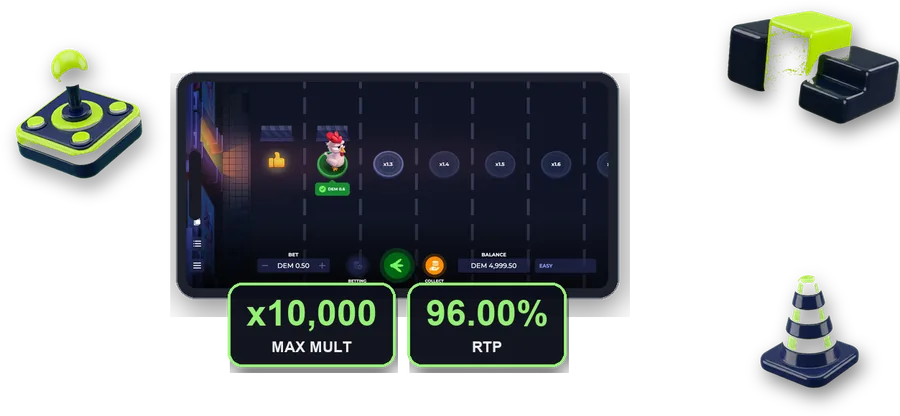
Once the round starts, Eggwina is placed at the edge of the road with traffic already moving, and the round is played one lane at a time from there. Each attempt ends either in a safe crossing, where Eggwina reaches the far side and comes to a stop, or a collision, which ends the round on the spot.
There is no partial outcome inside a single lane. A crossing either lands cleanly or it does not, and the traffic already set on the next lane is not influenced by what happened on the one before it, since each lane is generated independently under the difficulty chosen at the start.
A safe crossing does two things at once: it raises the stake's current value, and it opens a fresh decision window, covered in the next section, before the following lane is attempted. Nothing about the interface signals in advance whether the upcoming lane is routine or the one that ends the round.
That structure means a round has no fixed length by design. It runs until a collision happens or until the player chooses to stop, and the number of lanes crossed before either of those varies round to round, shaped by the difficulty setting rather than by anything decided mid-crossing.
The cash-out window between lanes
Cash-out opens only once Eggwina has stopped, and it closes the instant the next lane is attempted.
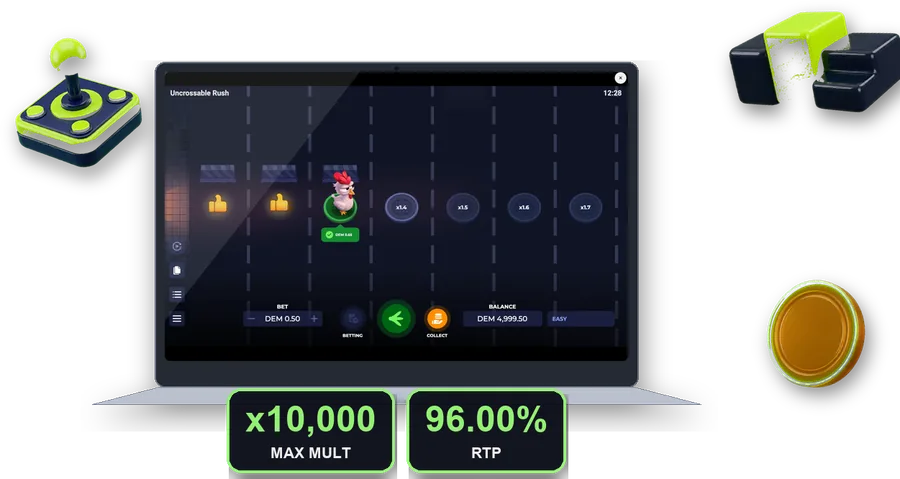
Cash-out becomes available the moment Eggwina finishes a crossing and comes to a stop between lanes. It is not available while a crossing is in progress, and it is not available once a collision has already ended the round; the window sits strictly between two lanes, nowhere else.
Taking it ends the round immediately and locks in whatever the running total shows at that instant. There is no delay between pressing cash-out and the round closing, and no further lane is offered once it has been taken.
Not acting inside that window and instead sending the same built-up stake into the next lane is the alternative, and it is not reversible once that next crossing begins. The stake carried forward is the full running total, not a fraction of it held back as a buffer.
Autoplay changes how that decision gets made, not what the decision is. Evoplay's autoplay settings include Cash Out On Win, which repeats the cash-out choice automatically after a defined pattern of results, alongside separate behaviour rules for what happens On Win and On Loss across a run of rounds.
What the player decides and what the game decides
Four choices sit with the player. Everything about a specific lane's outcome does not.
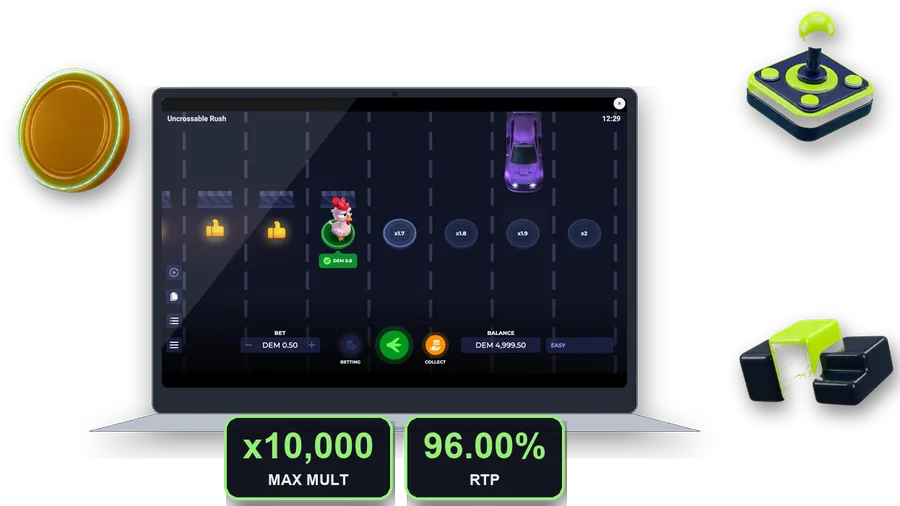
A player controls exactly four things in Uncrossable Rush: the difficulty level picked before the round starts, the stake, the decision to cash out or continue at each stop, and, when autoplay is used, the rule set that repeats those same two decisions across a run of rounds without a tap each time.
Everything else is generated by the game and is not something clicking faster, timing a crossing carefully, or watching the animation closely changes. Whether a given lane produces a collision or a safe crossing is resolved by the game itself under the difficulty setting already chosen, not by anything happening on screen in the moment.
The 96.00% RTP Evoplay publishes for the game as a whole sits in that second category too. Nothing a player decides mid-round, including the difficulty setting itself, is stated by Evoplay to move that published figure; a full breakdown of what the RTP number does and does not describe is on the RTP page of this site.
That split is worth keeping in mind before treating any in-round behaviour as a signal. A string of safe crossings or a run of early collisions describes what already happened, not a pattern the next lane is bound to follow, since each lane is generated independently of the ones before it.
Every control on screen, and what each one changes
Six controls decide everything a player chooses in a round. Two of them only apply once autoplay is switched on.
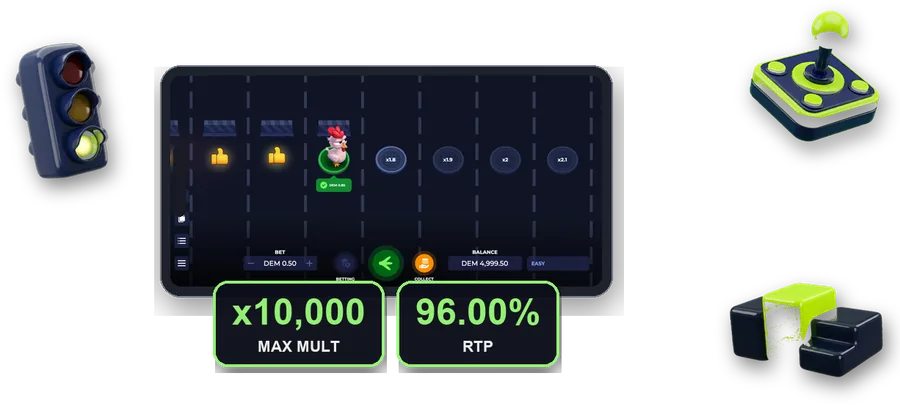
Uncrossable Rush exposes six controls across manual and autoplay play: the difficulty selector, the stake field, the start button, the cash-out button, and, inside autoplay specifically, the Cash Out On Win and On Win or On Loss behaviour settings alongside Stop on Profit, Stop on Loss, a fixed number of bets and a fixed bet size.
The table below lines up what each control does on screen against what it actually changes about the round's risk: some controls only touch the round already running, and only one changes what the game costs on average in the long run.
None of the six reaches the traffic itself. Which lane produces a collision and which one is crossed safely is not on this list, because that part of the round is not exposed to the player through any control, manual or automated.
| Control | What it does | What it changes in risk |
|---|---|---|
| Difficulty selector | Sets Easy, Medium, Hard or Hardcore before the round starts | Changes the traffic itself, speed and car count, for every lane in that round |
| Stake field | Sets the amount that rises with each safe crossing | No published minimum or maximum; decides the cash value of every lane crossed |
| Start / place bet | Locks in the stake and difficulty and begins the round | Nothing about either can be changed once this is pressed |
| Cash Out | Ends the round immediately at the running total shown | Converts the built-up value into a settled result and stops all further risk on that round |
| Cash Out On Win / behaviour rules | Repeats the cash-out decision automatically across an autoplay run | Applies the same rule to every round in the sequence, not a per-round choice |
| Stop on Profit / Stop on Loss | Ends an autoplay run once a preset result is reached | Caps how far a run can go in either direction without changing the round-by-round odds |
Which lane produces a collision, and which one is crossed safely, is not on this list: none of the six controls above reach that part of the round.
Straight answers
Uncrossable Rush · Evoplay
What do I choose before a round of Uncrossable Rush starts?
A difficulty level, Easy, Medium, Hard or Hardcore, and a stake. Both are fixed before Eggwina steps onto the road, and the difficulty holds for every lane in that round.
When can I cash out?
Only in the window right after Eggwina finishes a crossing and comes to a stop. Cash-out is not available mid-crossing or after a collision has already ended the round.
Can I change the difficulty setting partway through a round?
No. Evoplay describes difficulty as a setting chosen before the round starts, and it stays fixed for every lane crossed inside that round.
What happens if a car hits Eggwina?
The round ends immediately and the stake's built-up value is cleared, with no partial recovery from the lanes crossed safely before the hit.
What is the game's stake range in rupees?
Evoplay does not publish a minimum or maximum stake for Uncrossable Rush, in euros or any other currency, so this page states that gap rather than converting a figure that does not exist.
Does autoplay change how a round is actually played?
No. It repeats the same difficulty and cash-out decisions across a run of rounds automatically, through settings like Cash Out On Win, Stop on Profit and Stop on Loss; it does not add a control beyond what manual play already offers.